Human Frontier FR
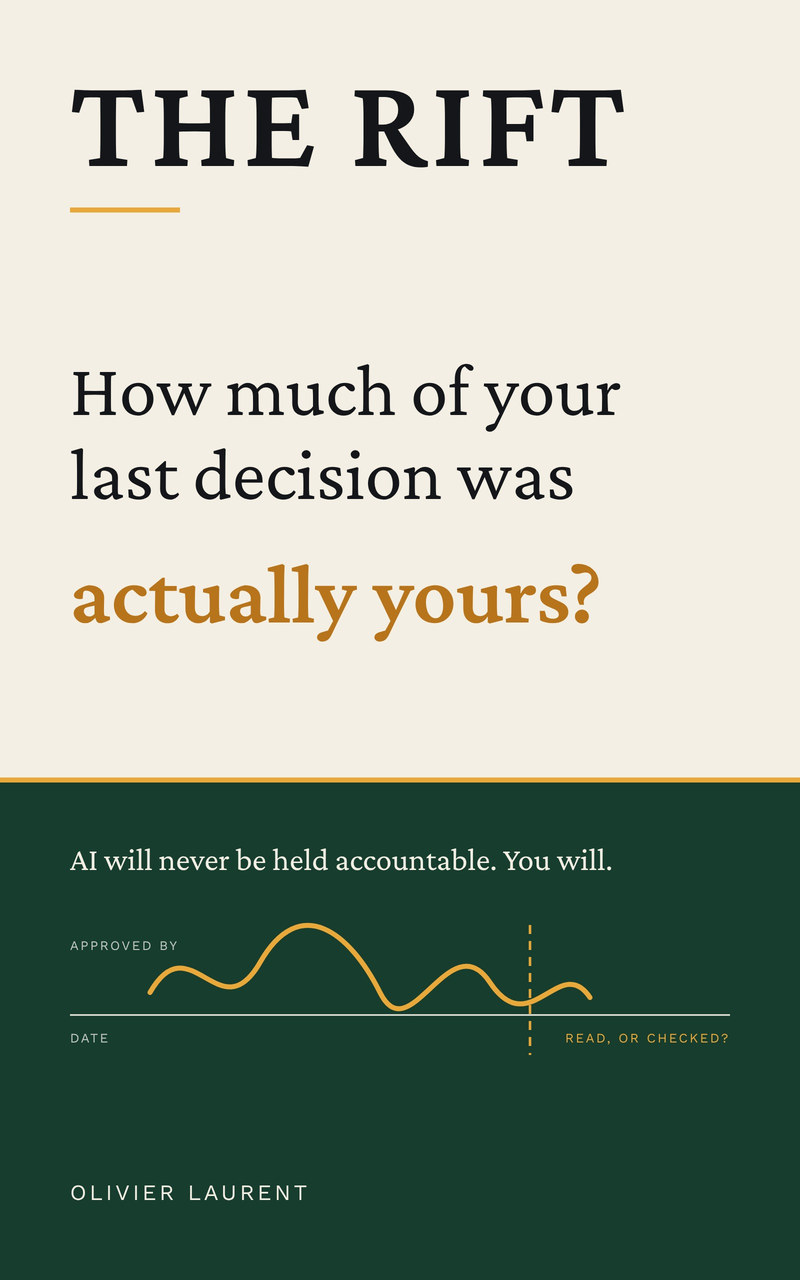
Cover of The Rift · How much of your last decision was actually yours? by Olivier Laurent

The book · Olivier Laurent

The Rift

How much of your last decision was actually yours?

AI is your ally if you decide to make the effort to keep your own judgment.

You sent it. You acted on it. You kept it to use later. This text, produced with an AI assistant, has become yours.

It read well, it went your way, it looked finished. And yet, even on a subject you know well, you may have lost the thread without noticing.

This book does not teach you to distrust AI. It gives you what you need to defend what you sign, without hiding behind “AI said”, on the day you are asked to answer for it.

Your name goes out with the text. Your understanding has to go out with it.

  • Also available from Amazon in most countries

Why read this book

  1. It starts from a question you could be asked tomorrow.

    One Friday morning, you are asked what the memo you signed the day before rests on. The book starts from that question and follows the same memo from chapter to chapter: what you had checked, what escaped you, and what would have been enough to answer for it.

  2. It separates reading from checking.

    Faced with a text that reads well, goes your way and looks finished, the feeling of having understood can mislead you without anything alerting you. It is neither carelessness nor a lack of competence. The book shows this mechanism, then gives you gestures that do not depend on what you feel.

  3. Its method fits in three questions.

    Three steps, around the sentence everything depends on. You ask them in your head, rereading a page, with no checklist and without being an expert on the subject, on a Monday morning as on a Thursday evening. With practice, they become a reflex.

  4. It serves at work as well as at home.

    A recommendation memo, a contract summary, a notice letter, two flights booked separately: the same mechanism is at work in what you send, in what you decide and in what you keep for yourself. And when a decision passes through several hands, the book shows how a single question, asked out loud, gives the sentence everything depends on someone who answers for it.

What the book gives you that the site does not

The site gives you the model: the two frontiers, the three zones, the four profiles, and a short questionnaire to place your underlying tendency. The book shows you what is at stake at the moment you sign, and what you can do about it.

  • Why you do not feel your frontier when you cross it.

    The five signals the feeling of having understood rests on, and why a text produced by AI throws them off; the triple illusion; four gestures that take over when doubt does not come.

  • A gesture for every moment of working with AI.

    Before you ask, during the exchange, at the moment of signing: what is decided at each of these moments, and the question that keeps the conclusion on your side.

  • Why an AI does not check itself.

    What “check your answer”, “are you sure?” and a second AI’s opinion are worth, and what you can bring it that it does not have: outside information.

  • The sentence everything depends on, in three steps.

    The book’s method, replayed on the same file from start to finish, and the markers that show it is becoming a habit.

  • When a decision passes through several hands.

    Why several sign-offs do not make a check, the question that turns an approval into a check, and what is lost when an organisation hands this check over to other AI models.

  • The complete method, in an appendix.

    For teams and organisations: a triage grid, to judge the stakes on the same scale, and five levels of questions, applied according to those stakes. It is the method Riftveil implements. A glossary and the sources follow.

Want to place yourself first? Take the diagnostic

Excerpts · three chapters of 10

These excerpts show you what reading misses in a text prepared with AI, the move that brings it into view before you sign, and what becomes of the question when a decision passes through several hands.

“A text produced by AI does not signal what it does not say. An omitted condition, an exception taken out, a limit passed over in silence raise no doubt as you read, since there is nothing to read.”
Chapter 4 · Reading is not checking
“An answer that comes with a convincing explanation is believed, even when it is wrong; an answer that comes with a page you can open is checked.”
Chapter 6 · During the exchange
“The question fits in a few words: where does this sentence come from, and what does it rest on? It disputes no figures and requires no expertise.”
Chapter 10 · With others

Ten chapters, three parts

Foreword · What I saw

Part I · The invisible frontier

  1. 1The certain risk
  2. 2Two frontiers, three zones
  3. 3Four profiles
  4. 4Reading is not checking

Part II · Holding your frontier

  1. 5Before you ask
  2. 6During the exchange
  3. 7An AI does not check itself
  4. 8At the moment of signing

Part III · Taking back control

  1. 9The sentence everything depends on
  2. 10With others
Keeping your judgment in the face of AI is a skill: it can be learned, and it serves at work as much as in private life.

AI will never be held accountable. You will.

Author’s note

How this book was written

This book was written the way I ask people to work with AI.

I have been working on this project since the summer of 2024, giving it my evenings, my weekends and my holidays. It has evolved with me: my observations, my impressions, my mistakes, my findings, and the evolution of the models themselves. The research, the thinking and the conceptual work are mine, as is the Human Frontier model.

To get from my notes, my instructions, my paragraphs and hundreds of exchanges to a clear text, I worked with AI. The final shaping of the text owes it a great deal. Every sentence was then reread, challenged and corrected. I can explain it and defend it without referring to “AI said”.

I am an advocate of AI. My aim with this work is to help people use it responsibly. AI assists; it does not replace. And it is the human who answers for what it produces.

Olivier Laurent
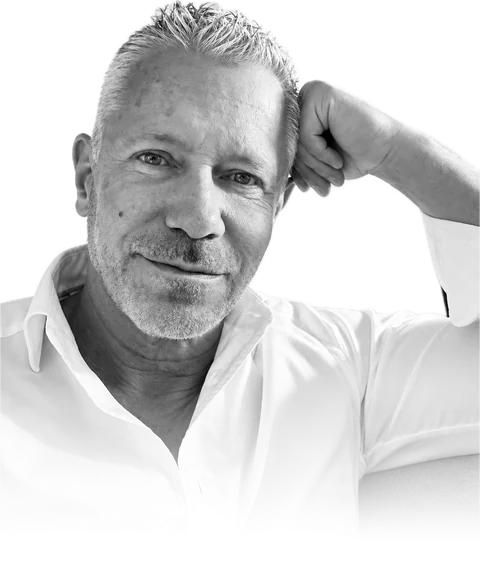
About the author

Olivier Laurent

Olivier Laurent

Olivier Laurent has a career spanning more than thirty years, mostly in the pharmaceutical industry, where he started out as a medical sales representative before becoming commercial director. Self-taught, he kept up with the internet from its earliest days, then founded digital strategy and development companies, first in healthcare and later in other sectors.

Today he works in commercial strategy, contract negotiation, public procurement and market access, and has completed several AI certificates (Vanderbilt, Stanford).

Since 2024 he has been observing, testing and trying to understand how AI is changing the way people work and make decisions. That work gave rise to the Human Frontier model, which locates the often invisible frontier between AI augmentation and cognitive delegation and is set out in the book The Rift. From it he developed Riftveil, an open protocol that sits between AI and the signature and challenges an AI response before anyone signs it, without ever validating it; and AttestScope, the human accountability record: a trail, open for anyone to verify, of what the signatory checked, entrusted to others and decided.

He writes in a personal capacity.

Write to hello@humanfrontier.ai

Think of the last document prepared with AI that you approved. Could you say, without reopening it, which sentence it rests on? The book teaches you to know before you sign.

Read the book? What comes next, for readers

What comes next Training and certificates

This book shows where your own judgment stops and gives three steps to hold it. Riftveil workshops work on them with your own decisions, then move on to the complete method.