Position

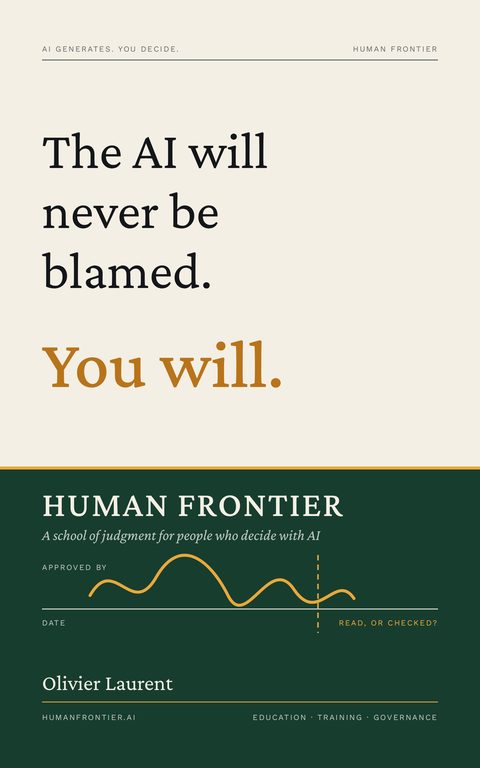
The AI will never be blamed. You will.

A school of judgment for people who decide with AI.

The failure mode we work on has a name: automation bias with a human signature.

When an AI-drafted memo goes wrong, nobody will ask the model. They will ask the person who signed it. That is the ordinary risk of this decade: professionals approving decisions an output had already written for them, because it read well and the meeting was in ten minutes.

The answer waits for no moratorium and no breakthrough. Education, so that people see where their judgment is being transferred. Training, so that they learn to challenge what they read. Strict governance by protocol, so that human oversight leaves a record.

Human Frontier is a school of judgment: education, training, and governance for people who decide with AI.

The founding principle

AI generates. You decide.

Between the work you still do by hand and the work you hand over without noticing lies a zone of dynamic mastery, where AI drafts and you keep the judgment. The line that matters is the second one: the point where judgment is transferred without anyone having decided it.

Take the 3-minute diagnostic Free · no account · four profiles, one result
L'IA génère. Tu arbitres. — the same principle, in French.
The frontier: two lines, three zones Human Frontier
Conservation zone Dynamic mastery zone Delegation zone Work done as before AI drafts · the person keeps judgment Judgment transferred, unnoticed JUDGMENT KEPT BY THE PERSON SHARE OF THE WORK DONE BY AI you are here? USE OF AI, INCREASING →
First line — visible. The moment you start using AI for the work. Everyone notices it.
Second line — invisible. The moment judgment moves to the output without a decision. Almost no one notices it.

Most people who use AI at work believe they are in the middle zone. The diagnostic tells you which of the four profiles you resemble, and what would move you toward the conscious navigator.

Who are you at the frontier

Four profiles · one of them is the destination
Conservation zone

The Conservative User

Uses AI little or not at all, and does the work as before. Keeps full judgment, at the cost of the time and the second perspective the tool would give.

Tell-tale sign — has a firm view on AI, and no output of their own to show for it.
Back across the first line

The Cautious Retreater

Tried it, met an error or an over-confident answer, and stepped back. Now trusts the tool less than it deserves on some tasks, and more than it deserves on others.

Tell-tale sign — “I checked it once and it was wrong”, and has not looked since.
Delegation zone

The Unconscious Delegator

Uses AI every day, reads fluent output, and signs. Judgment is transferred one paragraph at a time, and no decision to transfer it was ever taken.

Tell-tale sign — cannot say which sentence of the last memo was their own.
Dynamic mastery zone

The Conscious Navigator

Uses AI as a drafting partner and keeps the judgment. Knows what the output assumes, and what remains to be checked, before acting on it.

Tell-tale sign — asks the output a question before answering with it.
Take the 3-minute diagnostic A few questions about your last week of work · result on screen, nothing stored

Training

Learning to see what the output did not say
The book · start here

Human Frontier

The AI will never be blamed. You will.

Everyone is worried AI will make a mistake. Wrong worry. The mistake is already made, and it has your name on it: the memo you signed because it read fine. This book is about the ten seconds before you press send, and the method that makes them count. Four profiles, one of them is you. English and French editions included.

The kit · to train

Trainer kit under licence

Train-the-trainer material to run the frontier and the challenge method in your own sessions, under your name.

Deck · facilitator guide · exercises White-label diagnostic for your participants Licence on request — hello@humanfrontier.ai
The Challenge Lab · for your teams · in preparation

Challenge Lab

An in-company workshop on your own team's decisions, run by a Human Frontier certified trainer with the Riftveil Protocol.

Worked examples, then your own outputs In preparation — write to us to be put in touch when it opens.
Governance — the operational answer

Education shows the line. Governance keeps a record of where you stood.

Riftveil is the governance piece between an AI output and a human signature. You paste the output; the protocol challenges it on up to five levels, sets the stakes by triage, and returns a record: what holds up, what deserves scrutiny, what the output assumes and who can verify it, and the questions that stay open until a named person answers them. It never validates, never rewrites, and never concludes. The decision is yours.

Run Riftveil on your last AI output riftveil.ai · Free · nothing stored · open protocol, Apache 2.0
About the author

Olivier Laurent

Brussels, Belgium. Twenty years in the pharmaceutical industry across commercial strategy, contracts and pricing, plus fourteen years as a digital-health entrepreneur; trained in AI leadership (Vanderbilt) and AI in healthcare (Stanford). Writes Human Frontier in a personal capacity.

Writing on Medium · Riftveil

Olivier Laurent has spent twenty years in the pharmaceutical industry at the intersection of commercial strategy, contract negotiation, pricing and operational execution, in complex and regulated environments. He currently works on high-impact commercial decisions in Belgium and Luxembourg — hospital collaboration, post-patent strategy, long-term financial planning — in close contact with pricing committees, tender boards and hospital executives.

In between, he was an entrepreneur for fourteen years (2004–2018). He founded and ran two digital-health companies that built platforms for post-marketing studies, clinical trials, registries and patient engagement for leading pharmaceutical groups across Europe; launched a start-up selected as an Alpha Startup at Web Summit 2017; created a national clinical-research network in Luxembourg; and published early thought leadership on Health 2.0. Earlier still, as a sales director, he built and led a forty-person commercial organisation for a national product launch.

In 2024 he completed graduate-level programmes in generative AI leadership, trustworthy AI and prompt engineering (Vanderbilt University) and in AI in healthcare, including the evaluation of AI applications (Stanford University).

Human Frontier is his personal work on the evolution of human judgment in the age of AI: the often invisible line between being augmented by AI and delegating one's judgment to it — the moment one stops truly understanding what one is validating, without noticing. Riftveil is its operational answer. He writes in a personal capacity.
Stay in the loop

New writing, Riftveil releases, sector editions. No schedule, no filler.

Your address goes to the newsletter provider and nowhere else. Unsubscribe with one click. See the privacy note.
Why a method is needed. Models do not reliably check their own work, and people rarely have a method for checking it for them — Huang et al., Google DeepMind, ICLR 2024 · Kamoi et al., TACL 2024 · Tsui, 2025 (64.5 % blind spot, 14 open-weight, non-reasoning models) · Zhou et al., 2024 · Passi & Vorvoreanu, 2022, overreliance literature · Advait Sarkar, CACM 2024 · Randazzo et al., HBS Working Paper 26-021, 2026 (HBR, March 2026).
The manifesto. Human Frontier — Medium, English · Human Frontier — Medium, français Human oversight in practice — the direction of EU AI Act Article 14(4)(b) (providers of high-risk systems design for overseers who remain aware of automation bias), not a compliance label